
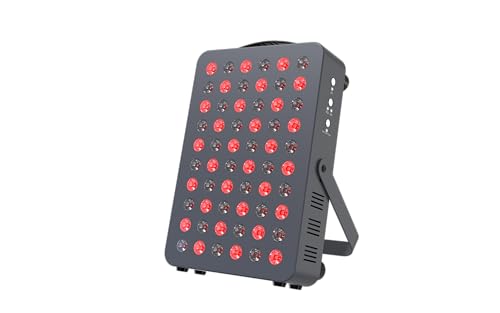
Hooga
HG300
$199
Pros & Cons
Pros
- Remarkably low price for a 60-LED dual-wavelength panel
- Built-in timer and kickstand for convenient tabletop use
- 660nm + 850nm wavelengths cover the most studied RLT range
- 60-degree beam angle for broad light dispersion
- 3-year warranty at this price is competitive
Cons
- No separate power controls for red vs. NIR channels
- Fans run at ~51 dB — audible during sessions
- Irradiance of ~70 mW/cm² at 6" is lower than premium panels
- Small coverage area — face and neck only per session
At a Glance
Overview
The Hooga HG300 is a compact 60-LED desktop panel built for people who want to try red light therapy without committing to a larger device. It delivers the two most-researched wavelengths — 660nm red and 850nm near-infrared — in a unit small enough to sit on a desk or nightstand. It's aimed squarely at first-time users interested in facial skincare, targeted joint or muscle work, or just getting a feel for whether red light therapy fits their routine.
The HG300's biggest selling point is its feature set for an entry-level panel. You get a built-in timer, a kickstand for hands-free tabletop use, and Hooga's 3-year warranty — things that budget competitors often skip. The 60-degree beam angle provides reasonably broad dispersion for a panel this size, and independent measurements put irradiance at roughly 70–73 mW/cm² at 6 inches, which is serviceable for skincare and surface-level recovery work.
Honestly, the limitations are just as important to understand as the strengths. The HG300's coverage area tops out at face and neck — it cannot treat your torso or lower body in any single session. There's no ability to run red and NIR channels independently, the cooling fans register around 51 dB (noticeable in a quiet room), and the two-wavelength design means you're missing the broader spectral coverage increasingly common on mid-range panels. If you know what you're getting — a legitimate entry-level tool — the HG300 earns its reputation.
Hooga HG300 Red Light Therapy Panel
Prices may change · Free shipping with Prime
Build Quality and Design
The HG300 is constructed from a black plastic housing with a metal mounting bracket that doubles as a kickstand. It's not going to win any design awards, but it feels solid for the price, and the stand holds a reliable angle without wobbling. The unit measures 14" x 8" x 3" and weighs 4.5 lbs — light enough to relocate easily but heavy enough to stay put on a surface.
The cooling fans are the one area where the build shows its budget roots. At approximately 51 dB, they're audible during sessions — comparable to a box fan on low. If you're using this in a home office or bedroom while someone else is sleeping nearby, it's worth knowing. LEDs are rated at 50,000+ hours and the unit ships from an FDA-registered facility, which adds at least baseline quality assurance for the diodes and electrical components.
Wavelength and Irradiance Performance
The HG300 runs 60 five-watt LEDs split evenly between 660nm and 850nm. These are the two wavelengths with the deepest research backing in photobiomodulation literature — 660nm for cellular energy production and surface-level skin repair, 850nm for deeper tissue penetration and inflammation modulation. Independent testing has confirmed Hooga's claims, with irradiance measured at around 70–73 mW/cm² at 6 inches from the panel.
What you won't get is the flexibility to use red or NIR channels independently — both wavelengths are always on together. That's fine for most general use cases, but it's a real limitation if your protocol calls for NIR-only work (common for sleep prep or joint recovery) without the red channel active. Flicker has been reported at roughly 100 Hz in some reviews, which is within acceptable range but falls short of flicker-free devices. EMF at 6 inches measures near zero, which is appropriate for a device used this close to the body.
Ease of Use and Setup
Setup is minimal — plug it in, position the stand, set the timer, and start your session. The built-in digital timer is a practical inclusion that many entry-level panels omit. There's no app, no Bluetooth, and no presets, which is actually a feature for users who want something simple and reliable.
The recommended treatment distance is 6 to 12 inches for skincare and facial work, 12 to 18 inches for broader surface coverage. Most sessions run 10 to 20 minutes per area. Because the panel only covers roughly a face-and-neck-sized zone, expect to reposition if you're treating multiple areas like neck, chest, or shoulders in one sitting.
Treatment Coverage and Session Times
This is where the HG300's size becomes the central factor. The 14" x 8" panel covers roughly face, forehead, and neck in one position — full facial coverage is the design sweet spot. Trying to use it for chest, back, or leg work requires multiple repositions and extended session times, which is workable but not efficient.
For targeted joint or muscle work — a sore knee, wrist, or shoulder — the HG300 performs well. The compact form factor is actually an advantage in those use cases. Where it falls short is for anyone wanting whole-body maintenance or recovery protocols that panels like the HG1000 address in a single session.
Value for Money
The HG300 pairs a 3-year warranty with the timer and kickstand features many entry-level panels omit. For someone who wants to build a daily skincare habit or experiment with red light therapy before committing to a larger device, that combination makes it a practical starting point. Check the dated commerce surface for the current price before comparing value.
The value calculus changes if you're already fairly certain you want broader body coverage or more wavelength flexibility. In that case, a larger model such as the Hooga HG1000, with 200 LEDs and full-torso coverage, may make more sense than buying the HG300 and upgrading later. The HG300 is the right first step when compact coverage and a simpler commitment are part of the picture.
Who Should Buy the Hooga HG300 — and Who Shouldn't
The HG300 is ideal for first-time red light therapy users who want a compact proof of concept, anyone whose primary interest is facial skincare or targeted use, and people who need a secondary panel for travel or desk use. Its 3-year warranty and included timer make the entry-level package easier to evaluate without relying on a frozen price claim.
Skip the HG300 if you want full-body coverage, independent red/NIR channel control, very low noise levels, or a broader wavelength spectrum. If you already expect to use a panel for broader body coverage, it may make more sense to start with a larger model and skip the upgrade cycle.
My Verdict
The HG300 is the go-to starter panel for anyone who wants to try red light therapy without committing to a larger full-body device. You get real 660nm + 850nm LEDs, a functional timer, and Hooga's 3-year warranty. Don't expect full-body coverage or premium irradiance, but for skincare and targeted use, it delivers solid value.
Hooga HG300 Red Light Therapy Panel
$199
Prices may change · Free shipping with Prime
| Full Specifications | |
|---|---|
| Wavelengths | 660nm + 850nm |
| Irradiance | 70mW/cm² |
| LED Count | 60 |
| Coverage Area | face / targeted |
| Power Draw | 60W |
| Dimensions | 14" x 8" x 3" |
| Weight | 4.5lbs |
| Wavelength Count | 2 |
| Built-in Timer | Yes |
| Pulsed Mode | No |
| Stand Included | Yes |
| EMF Level | low |
| Warranty | 3years |
| FDA Cleared | Yes |
Frequently Asked Questions
Is the Hooga HG300 a good value?
How long should I use the Hooga HG300 per session?
Does the Hooga HG300 emit EMF?
Can I run just the red or just the NIR channel on the HG300?
Hooga HG300 vs Hooga HG1000 — which should I buy?
Related Buying Guides
Compare With Similar Red Light Therapy Devices
Head-to-Head Comparisons
Hooga HG300 Red Light Therapy Panel
$199
Prices may change · Free shipping with Prime