
Updated March 3, 2026
NovaaLab
Novaa Deep Healing Pad
$350
At a Glance
Best For
Overview
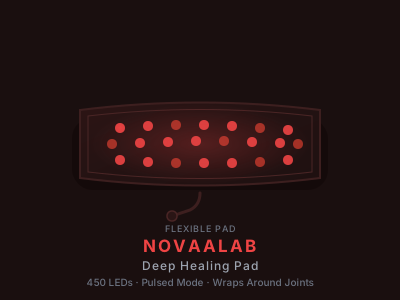
The NovaaLab Novaa Deep Healing Pad occupies a distinct category from rigid desktop panels: it's a flexible silicone LED pad designed to wrap around or lay directly against the body. With 450 LEDs packed into a 15.7" x 9" flexible surface, it's built for contact-based or close-proximity therapy on joints, muscle groups, and curved body areas that rigid panels struggle to address efficiently — think lower back, knees, shoulders, and hips.
The key differentiator here is the delivery method, not the wavelengths. Like most devices in its class, the pad uses 660nm red and 850nm near-infrared — the most researched combination in photobiomodulation. What's different is that contact-based or near-contact use allows the light to reach tissue without the intensity loss that occurs as distance increases on panel-based devices. The pad also includes a pulsed mode, letting users vary between continuous and pulsed output for different treatment goals.
At $350, the Deep Healing Pad is expensive relative to rigid budget panels, and the irradiance spec — 25 mW/cm² at 6 inches — looks underwhelming until you understand that this device is meant to be used at 0–2 inches. At contact distance the output is considerably higher (~150 mW/cm²), which is the relevant metric for a wrap-style therapy device. If flexibility and conformable coverage are priorities, this is a genuinely different tool than a desktop panel.
Pros & Cons
Pros
- Flexible pad design wraps around knees, elbows, and back
- 450 medical-grade LEDs (300x 850nm + 150x 660nm)
- Pulsed mode with adjustable frequency (1–999 Hz)
- 60-day risk-free trial and up to 3-year warranty
- Lightweight at 0.6 lbs — highly portable
Cons
- Irradiance drops to ~25 mW/cm² at 6" — lower than panel-style devices
- Not sold on Amazon — direct only
- Primarily designed for targeted use, not full-body coverage
- Flexible pads can be awkward to position without straps
NovaaLab Novaa Deep Healing Red Light Therapy Pad
Prices may change · Free shipping with Prime
Build Quality and Design
The pad uses a flexible silicone housing that's more durable than it looks. The LED array is distributed evenly across the surface, and the silicone construction means it can conform to the shape of a knee, lower back, or shoulder without putting pressure on the LEDs or creating uneven coverage. At 0.6 lbs, it's light enough to hold in place or position with a simple strap.
The control unit connects via a short cable and houses the timer and mode controls. The overall construction quality is solid for a consumer-grade flexible pad, though the cable connection point is worth monitoring over time — flex points on cable junctions are the most common failure mode for this device category. NovaaLab includes a 3-year warranty, which provides meaningful coverage for that concern.
Wavelength and Irradiance Performance
The 660nm + 850nm dual-wavelength combination is well-established in clinical research for soft tissue healing, pain modulation, and inflammation reduction — NovaaLab's wavelength choice is sound. The 450 LED count creates a high-density array across the pad's surface, enabling consistent coverage without hotspots.
Understanding the irradiance numbers requires context. At 6 inches, the pad measures 25 mW/cm² — which sounds low compared to desktop panels. But flexible pads are used at contact or near-contact distance (0–2 inches), where irradiance is measured around 150 mW/cm². That's the clinically relevant figure for most joint and back treatment protocols. The pulsed mode adds the ability to deliver light at intervals rather than continuously, which some protocols prefer for nerve-related conditions or sensitivity management.
Ease of Use and Setup
Using the pad requires minimal preparation — lay it against the target area, set the timer on the control unit, select continuous or pulsed mode, and begin. There's no stand, no positioning hardware, and no distance measurement required. For lower back use, users typically lie on the pad or drape it against the lumbar area while sitting. Knee and shoulder applications involve placing the pad against the joint and either holding it or using a compression sleeve.
The 10–20 minute recommended session time per area is appropriate for contact-based protocols. The built-in timer with automatic shutoff eliminates the need to track sessions manually, which matters when the device is used while resting or sleeping. The instructions could be more detailed for new users, but the basic operation is intuitive.
Treatment Coverage and Targeted Applications
At 15.7" x 9", the pad covers a useful targeted area — adequate for lower back coverage, a full knee, or both shoulders simultaneously if draped appropriately. It cannot cover full torso or full legs in a single session, and it's not designed for facial use. The design intent is clearly therapeutic treatment of specific pain or recovery sites rather than general wellness exposure.
User feedback clusters around back pain, joint pain, and post-workout muscle recovery. The flexible format makes it more practical for these applications than a rigid panel that would require awkward positioning. For chronic back pain or knee osteoarthritis management, the ability to deliver direct, sustained light contact to the affected area is a genuine advantage over panel-based devices.
Value for Money
At $350, the Deep Healing Pad is priced as a mid-range therapeutic device. Compared to budget rigid panels, it's expensive for the irradiance numbers if you read them out of context. Compared to other flexible LED pads and wraps in the same category, the price is competitive, the LED count is high, and the 3-year warranty is above average.
The value calculation depends entirely on your use case. If you need targeted joint or back therapy with conformable coverage, the pad format justifies the cost. If your goals are primarily facial skincare or general full-body wellness, a rigid panel offers better coverage efficiency at a lower price. The two devices serve meaningfully different needs, and the comparison only makes sense when use case is factored in.
Who Should Buy the NovaaLab Deep Healing Pad — and Who Shouldn't
Buy the Deep Healing Pad if you have a specific chronic pain target area — lower back, knees, hips, or shoulders — where a conformable pad is more practical than a rigid panel. It's also a good fit if you're supplementing a rigid panel setup and want to add targeted body-area coverage without repositioning a large device.
Skip it if your primary interest is facial skincare, full-body wellness sessions, or high-irradiance desktop use. A rigid panel in the $159–$400 range will serve those goals better at equal or lower cost. Also note that this device has not been independently EMF-tested at the level of some competitors — the spec sheet lists "not tested" — which may matter to sensitive users.
Our Verdict
NovaaLab's Deep Healing Pad is well-suited for joint and localized muscle recovery — the flexible format lets you wrap it around problem areas where rigid panels can't reach. The pulsed mode is a bonus rarely seen at this price. Irradiance is modest, so committed biohackers will want more power eventually.
NovaaLab Novaa Deep Healing Red Light Therapy Pad
$350
Prices may change · Free shipping with Prime
| Full Specifications | |
|---|---|
| Wavelengths | 660nm + 850nm |
| Irradiance | 25mW/cm² |
| LED Count | 450 |
| Coverage Area | targeted |
| Power Draw | 45W |
| Dimensions | 16.3" x 7.9" |
| Weight | 0.6lbs |
| Wavelength Count | 2 |
| Built-in Timer | Yes |
| Pulsed Mode | Yes |
| Stand Included | No |
| EMF Level | not tested |
| Warranty | 3years |
| FDA Cleared | No |
Frequently Asked Questions
Is the NovaaLab Deep Healing Pad worth $350?
How long should I use the NovaaLab Deep Healing Pad per session?
What's the difference between continuous and pulsed mode on the Deep Healing Pad?
Can I use the Deep Healing Pad for lower back pain?
NovaaLab Deep Healing Pad vs a rigid desktop panel — which should I choose?
Related Buying Guides
Compare With Similar Red Light Therapy Devices
Mito Red Light
MitoMIN 2.0
660nm + 850nm · 75 mW/cm² · 60
$299
Mito Red Light
MitoPRO 300+
630nm + 660nm + 830nm + 850nm · 100 mW/cm² · 60
$349
Head-to-Head Comparisons
NovaaLab Novaa Deep Healing Red Light Therapy Pad
$350
Prices may change · Free shipping with Prime